home    company profile    products    buyers guide   code of practice    gallery    links    contact         


An Outstanding Investment For Any Family
A home tennis court represents not only an outstanding investment but also an opportunity for the whole family to enjoy healthy outdoor activity within the safe confines of their own home.

A well designed and built tennis court can increase the value of the family home by more than the cost of the court.

Kevin McNamara tennis courts are recognised as a "blue chip" investment. An investment that will return many years of the problem free family enjoyment.

Choose a Surface
You can choose from the following surfaces:

bullet

Synthetic Grass - Australia's favourite tennis court surface.

bullet

Synthetic Acrylic - A colourful hard wearing surface.

bullet

Red Porous - A perennial favourite for club tennis.

No matter which surface, Kevin McNamara tennis courts are built to stand the test of time.


State of the Art Floodlighting
Ideal for both club and home courts, Kevin McNamara's environmental floodlighting systems enable you to floodlight your tennis court and keep your neighbours in the dark.

Make the most of your tennis court investment with a Kevin McNamara floodlighting system.

Tennis courts that blend with the garden landscape
Kevin McNamara's experience in landscape design and construction means that he views a home tennis court as an opportunity to create a multi-use sports area which complements the garden and outdoor living areas.

Kevin will gladly provide a landscape concept plan with your tennis court quotation.

Design and innovation that leads the field
There is no doubt that the appearance of tennis courts has changed greatly since 1973. Many of the changes have been introduced by Kevin McNamara.

Examples include the following:

bullet The octagonal court (with diagonal corners) introduced in 1979.
bullet The Quick-Flo drainage system for synthetic grass courts - more playing time - less down time.
bullet Lightweight fencing systems resulting in a minimum of steel work in your tennis court fence - ideal for garden settings.

Kevin also specialises in custom designed fencing systems to provide a dramatic backdrop for your tennis court.

Many Purposes
Modern synthetic grass surfaces allow your tennis court to be used for many activities as well as tennis:

bullet Basketball
bullet Netball
bullet Volleyball
bullet Cricket
bullet Football
bullet Golf putting

These are just a few of the activities you can enjoy on your new Kevin McNamara court.

Tennis Courts - An Historical Perspective


Melbourne Cricket Club foundation tennis members C. 1879. (M.C.C.)

In 1879, Australia's first tennis court was constructed for the Melbourne Cricket Club - two years after the Wimbledon Championships commenced.

Surprisingly, the first tennis court had a synthetic surface of sorts - asphalt.

The game proved so popular that the MCC built a second court the following year by which time inter-club matches were being played.

Tennis was almost certainly being played on the lawns of Melbourne's more stately homes prior to 1879, but the limitations of grass soon led to the widespread construction of asphalt surfaces, thus ensuring year round play.


Norman Brookes (later Sir Norman) the
first non Briton to win the Wimbledon
singles championship (1907). He was a
member of Australia's first successful
Davis Cup team the same year. (Jim
Entink Collection)

Tennis was all the rage for wealthy 19th century Victorians and the tennis court often provided a focal point for garden parties and other social activity.

 The first tennis court floodlighting systems, using carbon arc lamps were installed before the turn of the century.

 The popularity of tennis quickly spread to country areas and the game soon developed an egalitarian quality which has lasted to the present day.

 In Australia and more particularly Victoria, the love of tennis is rooted deeply in our culture.

For well over 100 years, tennis has been a favourite pastime for Victorians and for just as long, many of them have aspired to that most enjoyable investment - their own tennis court.


Tennis Party at Coal Creek near Korumburra. C. 1890 (Melbourne University Archives)

Of course today's tennis courts are expected to be capable of accommodating many activities as well as tennis. Depending upon your preference a synthetic surfaced tennis court can also be used as anything from a securely fenced general play area to a venue for a game of backyard cricket, football or netball!

Advances in Technology


Low wage costs meant that many of last Century's tennis courts were built using picks and shovels. No doubt progressive contractors soon found that horse drawn equipment often improved productivity.

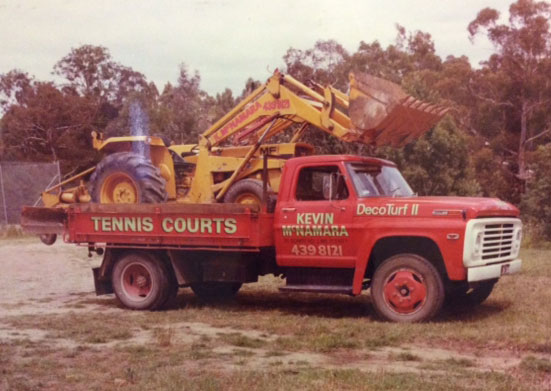
The loader/grader pictured (right) with manual controls, was state of the art in 1973.

 
The purpose built, laser guided grader (below), can level a tennis court to tolerances of a few   millimetres, using the latest in computer technology.   In the hands of an experienced operator like Brian Smyth, with over 25 years experience building tennis courts, it becomes a formidable construction tool.

Investing in a Tennis Court
The Real Estate Experts seem to agree on one thing - Tennis Courts are a great investment.

"If you have the choice between putting in a tennis court or a pool, a tennis court is the better investment. "They're more versatile and apart from playing tennis can be used for hockey practice, cricket, football, and other games.
Christopher Koren of Koren Vickers - Willis: Melbourne Weekly - Real Estate Guide

"Even if the tennis court is run down it will still add value to property ..... In some cases swimming pools add very little value to a house whereas a tennis court will always add value because of the land factor. "
Alistair Craig of Richard Jellis: Melbourne Weekly - Real Estate Guide

"The tennis court adds a huge component of value to property in Portsea and Sorrento. The opportunity for healthy outdoor activity and post tennis lunch parties is high on our client's agenda"
Jensen, Kay & Burton - Portsea

"What exactly does $1 million buy! A glamor property with a pool! Maybe. But to secure a floodlit tennis court, which some agents say is the most  important element of a million-dollar-plus home, you'll need to find significantly more . "
Elisabeth Tarica writing in the Sunday Age - Sunday Property

In addition to the financial benefits of a home tennis court, the most important dividend most families enjoy is the opportunity for safe, healthy recreation for themselves and their friends.


Getting Started

bullet Choosing a Contractor
bullet Landscape Planning
bullet The Low Price Cycle
bullet The Purchasing Decision
bullet Planning Permits

Choosing a Contractor
Once you have decided to build a court, your next step should be to seek advice from a reputable, experienced contractor.

Make sure the contractor can:

  1. Properly advise you on the best siting for your court in relation to the living areas of your house and the existing landscape features. At the time of quoting, the contractor should also be able to provide you with suggestions on landscaping your completed court. A well designed and located court will integrate readily into your garden.
  2. Explain what permits (if any) are necessary for your new tennis court and take responsibility for obtaining those permits.
  3. Advise on the advantages and disadvantages of each type of surface; synthetic grass, synthetic acrylic or red porous.
  4. Provide a written guarantee on his/her work.

If you are not familiar with the contractor's work, ask for the names and addresses of some previous clients in your neighbourhood.

Landscape Planning
Each year I see many examples of poorly designed tennis courts that detract from the rest of the property.

A well designed tennis court will integrate readily into your garden. Many of my clients initially find it difficult to visualise the finished court in their garden.

In these circumstances, I normally suggest preparation of a landscape plan showing the new tennis court together with adjacent landscape features.

The Low Price Cycle
Each year many court buyers and court builders get caught in the low price cycle. The court builder is anxious to sell tennis courts and falls for the trap of quoting at unrealistically low prices.


A well designed tennis court will integrate readily into your garden.

The builder is then forced to take short cuts when building the court and use the cheapest available materials.
Inevitably problems arise with the court and the contractor (if he/she is still in business) cannot afford to properly rectify them thus leaving a disgruntled client unwilling to recommend the builder to friends.

The builder unable to win further work from recommendation cuts prices (and quality) further.

The Purchasing Decision
Many people mistakenly make a purchasing decision for their tennis court based purely on price, in much the same way as they might shop around for a particular brand of new car.

Because tennis courts are not produced on a production line in a factory, the quality of your new court will depend upon the skill and experience of your court builder, the quality of materials used and to some extent the price you are paying for your court to be built.

If your major objective is a low priced tennis court it is unrealistic to also expect a top quality finished product.

Earthworks
If the proposed site for your tennis court is sloping, it will be necessary to cut and fill the ground to obtain the optimum grade for your tennis court pavement (this varies from .4% to 1% depending upon the type of court surface chosen).

In years gone by, the normal practice was to excavate the site and then allow the fill to settle for a period of 3 to 12 months, Because natural settlement can continue for 25 years or more, this practice often led to the court owner facing expensive repair bills after completion of the tennis court.

A more sensible method is to compact the fill mechanically during excavation works, This will involve the use of a vibrating sheepsfoot or smooth drum roller (depending upon the type of material being compacted). It is also important that the fill is compacted in layers -rolling only the surface is NOT sufficient.

Today, compacting equipment is so effective and the science of soil mechanics so advanced that roads, freeways and even buildings are constructed on compacted fill. A competent, experienced tennis court contractor will be able to explain the steps necessary to provide a stable foundation for your tennis court and will have no hesitation in guaranteeing his work.

Be especially wary of any contractor who suggests that it is better that you arrange earthworks separately. Under this arrangement you are the one who may have to foot the bill for future repairs if the earthworks are not prepared correctly.

Read more about earthworks in the Code of Practice


A home tennis court provides year-round enjoyment for children. A tennis Court can also be used for a multitude of other ball sports.

Retaining Walls
Like earthworks, retaining walls are an important structural element of your tennis court. On the cut side of your site, a retaining wall will normally be necessary to prevent water or soil washing onto the court surface from above.


Railway sleeper walls offer dubious structural integrity.

Retaining walls can be constructed from a number of different materials, stone, brick or even railway sleepers.

Stone is the most popular medium because of its moderate cost and, if properly constructed, attractive appearance. Brick retaining walls although suited to some sites can be quite expensive.

Railway sleeper walls are usually moderately priced but offer a limited life span and often dubious structural integrity.

Whatever retaining wall you choose, insist that is be built to an engineer's specification


Stone retaining walls combine natural beauty with strength.

A cheap retaining wall that collapses onto your court will  prove a very expensive proposition in the long run.

Approvals Required

Planning Permits
In 1993 I met with the Victoria Minister for Planning on behalf of the Tennis Court Builders' Association of Australia. As a result of this meeting, the Minister decided that the existing planning controls for tennis courts were too complex and suggested that these controls should be replaced by a Code of Practice.

In August 1996, after a lengthy period of drafting and discussion the "Code of Practice - Private Tennis Court Development" was approved by the Minister and signed into law.

Under the Code of Practice, provided a proposed tennis court meets certain standards regarding court location and extent of earthwork etc. and is not located in an area affected by environmental overlay planning controls or an urban conservation zone, it may be constructed without a planning permit.

The Code of Practice removes many of the frustrations and delays involved with the old system of planning permits and encourages sensitive tennis court design.

To Access the Code of Practice click here:

Building Permits
Amendments to the Victoria Building Control Act in February 1997 mean that a standard tennis court no longer requires a building permit. 

Retaining walls higher than 1.0 metre costing more than $5,000, still require a permit as does non standard tennis court fencing (other than chain mesh type) higher than 2,0 metres.

Your local council no longer has a monopoly on the issuing of permits, today building permits may also be issued by independent building surveyors.

Easements
If the Tennis Court encroaches on an easement the approval of any statutory body with an interest in the easement may also be required.

NOTE: Because regulations change from time to time you can contact any of my offices for up to date information on approval requirements.
The information detailed here applies only to Victoria.

Court Sizes
While the line marked area of the tennis court does not vary, the fenced area may.

The most popular sizes are:

INTERNATIONAL COURT

36.5m x 18.2m
(120' x 60')

COMPETITION COURT

This is the most popular size for home courts

33.0m x 16.4m
(108' x 54')

REGULATION COURT

30.5m x 15.2m
(100' x 50')


Court Surfaces
The most commonly used surfaces are synthetic grass, red porous & synthetic acrylic.
I will also deal briefly with granitic sand, asphalt & concrete surfaces.

1. SYNTHETIC GRASS
Synthetic grass consists of a polypropylene carpet filled with specially graded sand, which is normally laid on a reinforced concrete base. The surface was first installed in North America in 1913.

Since its introduction to Australia under the brand name 'Omnicourt', this surface has increased in popularity to a point where it is by far the most popular tennis surface nationwide.

The reasons for this can be summarised as follows:

  1. Appearance - not unlike a natural grass court.

  2. Durability - a good quality synthetic grass court will provide many years of trouble free use.

  3. Player comfort - the sand infill ensures that the surface 'gives' slightly underfoot.

  4. Flexibility of use - synthetic grass can be used for other sports, such as volleyball, basketball, netball, cricket, football or even as a golf putting green.

  5. Synthetic grass is a low maintenance surface.

  6. The surface drains quickly after rain.

Most synthetic grass is manufactured in Australia using yarn that is sourced from either Australia, Europe or the United States of America.

My personal favourite is "Polyloom" yarn manufactured in the United States. The first synthetic grass courts installed in Australia in 1978 used 5700 denier 'Polyloom' yarn.

In 1983 'Polyloom' developed a 10,000 denier yarn which has proved to be exceptionally durable and remains in use in the 'Omnicourt' product to this day.

While 'Omnicourt' may be a little more expensive initially, its exceptional durability means a very low "annual cost".

European yarns have a relatively short track record under Australian conditions. Because synthetic grass is rarely used for tennis courts in Europe, often European yarns have characteristics best suited for sports such as hockey and soccer.

Some Australian yarns have experienced problems with durability in the past and I am sure the local manufacturers are working hard to improve their product. However at this time, I would only recommend Australian yarn as a cost saving measure.

The Omnicourt, Polyloom story

Read more on Omnicourt
In 1973, Canadian, Seymour Tomarin, invented the sand filled artificial grass concept. He subsequently applied for patents on his invention and established 'Omnisport International'.

Then as now, he insisted that his carpet be manufactured from the world's finest yarn - 'Polyloom'. The Polyloom Corporation invented polypropylene yarn and remains the world's largest manufacturer of slit fibrillated yarn.

From his manufacturing plant in Dalton, Georgia, Omnicourt was distributed to many parts of the world. The earliest examples were installed in Australia in 1981. many of these early 5700 denier court remain in use to this day.

Today, the Omnicourt synthetic grass product is manufactured in Dandenong, Victoria, for distribution throughout Australasia, South East Asia and North America.

The Polyloom yarn used in Omnicourt's products is not available with any other brand of synthetic grass.

Although a multitude of imitators have since entered the marketplace, Omnisport can still make a unique statement - a statement that is the envy of other synthetic grass manufacturers:

"After 19 years of installing and manufacturing 'Omnicourt' in Australia, not one Omnicourt surface has worn out or failed during the warranty period"

The Omnicourt/Polyloom track record is unique. No product can match its performance under harsh Australian U.V. radiation. Even in commercial and club installations there are many examples of Omnicourt which have provided 15 years or more of trouble free use.

Discover why Omnicourt continues to outperform its imitators - Kevin McNamara will be happy to arrange an inspection of a genuine 'Omnicourt' in your neighbourhood.

Kevin McNamara holds exclusive rights to install Omnicourt in Victoria.

2. RED POROUS
The red porous surface consists of a crushed red brick surface laid over several layers of porous crushed scoria.

First developed around 1930, this surface has been a perennial favourite for club play since.

The main advantages of red porous are:

  1. The surface drains quickly after rain.

  2. It is comfortable to play on.

  3. Red porous is relatively low in cost. 

The main disadvantages of a red porous court are that it requires regular watering, quite a lot of maintenance and can be easily damaged by incorrect footwear or even children riding bikes on the court. This reduces its attraction to many home court buyers.

3. SYNTHETIC ACRYLIC
This is a colourful surface normally laid on an asphalt base. The finished court is similar in appearance to a painted surface. 


Twenty four synthetic acrylic courts at the Traralgon Tennis Centre

Synthetic acrylic surfaces are a low maintenance and durable alternative that continue to be a popular choice for school tennis and tournament play courts.

Their popularity as home courts has continued to decline since the introduction of the synthetic grass surface.

The most common complaint against the synthetic acrylic surface is that it is 'hard on the legs'.

Like the red porous court the synthetic acrylic surface can be damaged by incorrect footwear or activities such as bike riding.

Unlike red porous or synthetic grass the acrylic surface can be rendered unplayable by light rain or even a heavy dew.

4. OTHER SURFACES

GRANITIC SAND
(Granitic gravel) like the red porous surface, this is a relatively low cost surface, but because of its cream colour a granitic sand surface presents some problems with surface glare and has a less attractive appearance than a Red Porous surface.

Granitic sand tennis courts often become unstable and "puggy" when wet, meaning the court will be unplayable for long periods after rain.

ASPHALT & CONCRETE
These surfaces should only be considered as a temporary playing surface prior to conversion to synthetic acrylic or synthetic grass.


Asphalt pavements can be readily damaged by tree root intrusion.

Asphalt has a little more "give" than concrete and for this reason is often favoured as a base for synthetic acrylic. Unfortunately asphalt suffers damage from root intrusion if trees are growing close to the tennis court and is more easily damaged by ground movement.

Concrete, because of its inherent strength and stability is an ideal base for a synthetic grass surface (synthetic grass provides adequate cushioning within the surface itself).

Your synthetic grass carpet is a long term investment and installing it on a second rate base represents false economy. A properly designed reinforced concrete slab will provide years of trouble free service.

Court Maintenance
Compared to swimming pools or garden areas, all tennis courts are relatively low maintenance.

Leaves and other organic matter should not be left lying on any surface for lengthy periods.

Red porous courts require extensive initial rolling, an adequate supply of water (the surface should not be allowed to dry out during summer) and an annual topdressing.

Many tennis court contractors provide a regular maintenance service.

Floodlighting

BOX LIGHTS
The introduction of the Code of Practice means that most tennis courts can be floodlit without the need for a Planning Permit provided:

  1. The tennis court is located at least three metres from an adjoining dwelling.
  2. The lights installed meet the strictest standards regarding light spillage outside the court and emission of glare.

Quite often people assume that any of the so-called 'Box Lights' will automatically satisfy the light spillage and glare requirements of the Code. This is far from correct. The simple fact is that very few 'Box Lights' can restrict spillage to 10 lux, three metres outside the court (as required in the Code).

It disappoints me that some contractors are installing floodlighting installations using 'Box Lights" that not only provide mediocre on court illumination' but also fail to meet the standards required under the 'Code of Practice'.

In these situations the problem is usually not discovered until well after the tennis court is completed and a neighbour complains to the Council, The Council may then order that the lights be switched off until the installation can be made to comply with the necessary standards.

WHAT MAKES A GOOD LIGHTING INSTALLATION?


Metal halide "box lights" have become a favoured lighting system for home courts

Apart from controlling light spillage and glare a good lighting installation will provide uniform light across the court, While the human eye can adapt to low level of light it finds it very difficult to accurately trace a small fast moving object (such as a tennis ball) through "hot" spots and dark areas.

On court glare must also be minimised and to this end I recommend a mounting height of 8.0 metres for your lights (the maximum height allowed under the Code of Practice). At this mounting height a good quality lighting system will provide excellent uniformity and minimal glare.

I would also recommend that you use a 1000 watt light fitting and not a 1500 watt fitting.

Because most 1500 watt fittings use a 1000 watt lamp that is 'overrun' by 50%, the lamp life is drastically reduced. The higher operating temperatures and greater U.V. emission tends to seriously affect the seals in the fitting and the reliability of running gear (ballasts etc.), Because of the higher output with a 1500 watt fitting, any problems with glare are increased by 50% and even with an 8.0 metre mounting height, lighting uniformity tends to be poor.

For all these reasons I recommend a 1000 watt Box Light. A top quality fitting such as "Spectra Ace" will provide excellent on court illumination and sharp spill light cut off, with four light fittings.

Court Orientation
Most tennis players will tell you that the ideal orientation for a tennis court is north/south.

Other people (usually not tennis players) will assure you that a north/south orientation means that you will never get the sun in your eyes.

While the first statement is partly correct, the second is definitely not.

Because the sun's path is constantly changing the ideal axis for a tennis court actually varies according to the time of year, but it generally approximates a true north/south alignment.

Even with this orientation, a right handed player will experience some problems with the sun in the morning from the southern end of the court. In the afternoon a left handed player will have similar difficulty.

On an east/west court, the roles are reversed, with right handers having most difficulty in the afternoon and left handers in the morning.

While the effect of the sun is somewhat greater on an east/west court, this can be reduced by planning the court siting to take advantage of screening provided by existing trees and buildings.

Often the benefits of siting a court east/west (such as reduced excavation works) far outweigh any other considerations.

Many courts are used mainly under floodlights thus further lessening the problem.


Kevin McNamara & Son    privacy statement    site map    site by